Recognizing the Escarpment Live Oak
Not all live oaks are the same
Growing up in Central Texas, I've long admired the rugged beauty of live oak trees. Since the area used to be a forest of live oaks, large old specimens are abundant. In Central Texas, their evergreen leaves keep some color in the outdoors all year long. Even in the coldest days of winter, a person can look up and see green.
In a native plants class in college, I was taught that these trees were Quercus virginiana. That struck me as odd - why would a very native Texas tree be named after Virginia? I've since become resigned to this quirk of naming - the first Europeans that saw the plant or tree or bird named it after where they first saw it, never mind that it's common in half the continent.
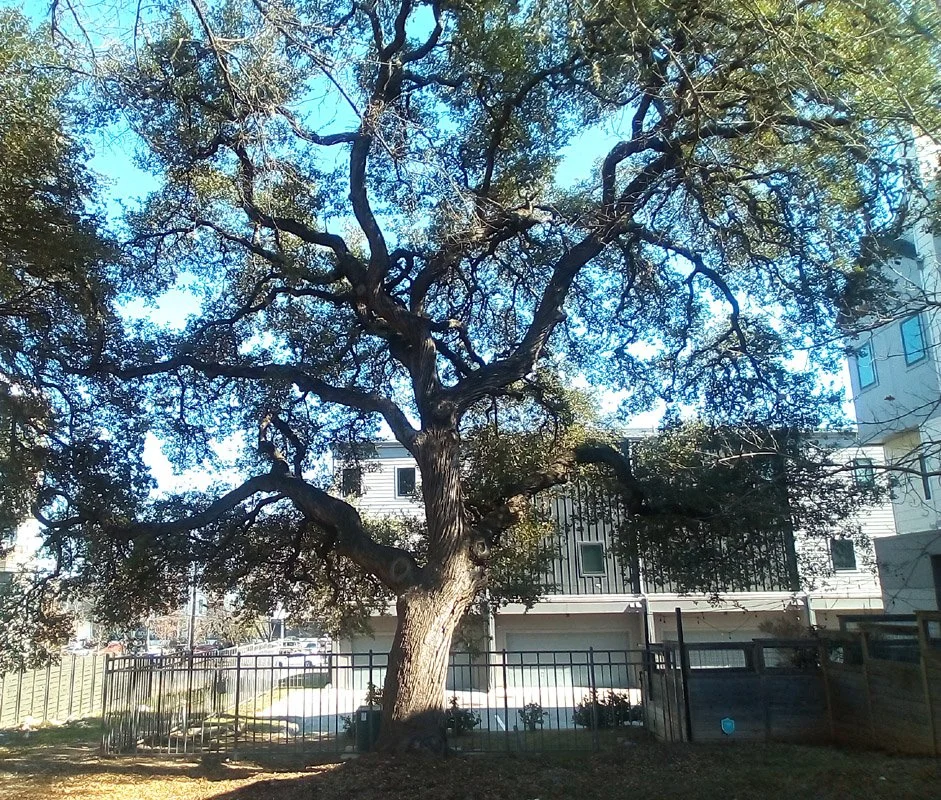
[Picture: Escarpment or Texas live oak tree near my home]
Later, however, I discovered that there are actually two main types of live oak in the US, and the one common in Central Texas is not Quercus virginiana, but Quercus fusiformis. Its common name is escarpment live oak, or, get this, Texas live oak. Main range is Central Texas, Edwards Plateau, and the Hill Country, you know, here. (When I was in college, fusiformis was considered a subspecies of virginiana, but later taxonomy improvements elevated it to full species status.)
The distinction between the two matters, because Quercus virginiana isn’t well adapted to Central Texas conditions. It prefers moist, well-drained soils and performs poorly in dry, rocky, or caliche soils, which tells you right off that it wouldn’t form a forest here. Quercus fusiformis, on the other hand, handles heat, wind, and drought well, and is even more cold-tolerant than virginiana. It thrives in limestone-based landscapes, that thin, rocky, alkaline soil so common in Central Texas. No wonder Quercus fusiformis dominated the ancient forest that was here.
These two oak species also have very different growth habits. When I first read the description of Quercus fusiformis, I thought, those are my trees, I know those trees, they are by the schools, in the parks, even around the block. They tend to be a bit shorter and have branches that grow outward more than upward, twisting and spreading in beautiful, sometimes strange forms. Quercus virginiana, by contrast, tends to grow taller and more upright, the classic "plantation" oak.
Of course, as with many plants, it's not quite that simple. The two species hybridize freely, especially in Central and South Texas, and many trees fall somewhere in between in both form and tolerance. Still, most of the live oaks thriving in Central Texas are escarpment—or Texas—live oaks.
