Did You Say Epicormic Branches?
The new branches that saved my tree after disaster
In February 2021, Central Texas endured an unprecedented winter storm. A little piece of the Arctic came down to visit. The area was snowed under for almost a week, with temperatures below freezing for days and lows dipping into the single digits.
The ash tree in my front yard was not meant for this kind of weather. When the snow and ice finally melted, I thought the shriveled leaf buds on the tree were just waiting for warmth to open. But no, they were dried and dead. Although I resisted seeing this, the grim truth became inescapable — every single branch on the tree had died. Not just the leaf buds, not just some north-facing branches, but all of them. I thought the tree itself was gone.
What I couldn't see was that the roots were very much alive. Once spring set in, little buds on the main branches woke up and began growing. The tree had leaves again! I was so relieved.
Then I found out about suckers. Were these suckers? Suckers look like branches and have leaves, but they drain the tree rather than contributing to its health.
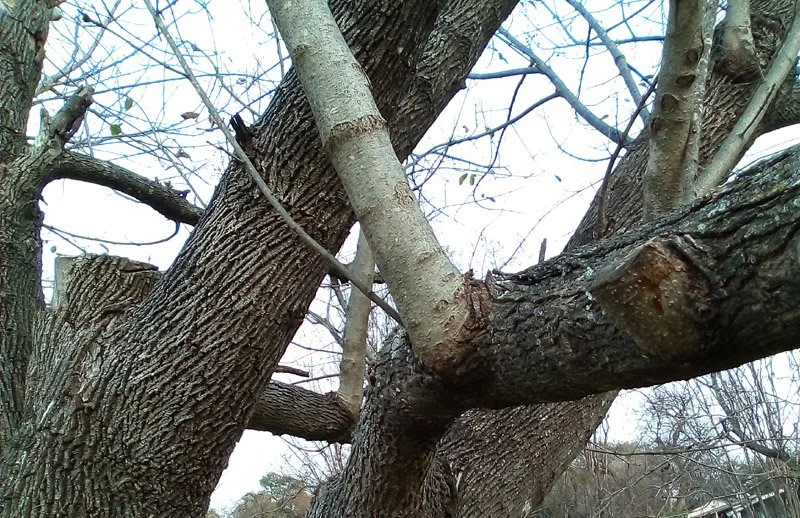
[Picture: Epicormic branch growing from old main branch, distinguished by its smoother bark. Stump of old trunk on the left.]
After some further research, I discovered that the new branches on my ash were what are called epicormic branches. Not the same thing as suckers; those actually start from the roots. Epicormic branches may not fully succeed in becoming productive parts of the tree, but with the right circumstances, they can. The tree was on the road to recovery.
I pruned away small weak branches, as well as branches growing downward or on the trunk. Left the rest to do their thing. Arborists did a good job cutting away all the deadwood, which included a large main trunk. Over the years, a number of the epicormic branches have grown tall and strong. At least in my case, the epicormic branches saved the tree.
If you have ever heard of pollarding, it works on the same principle. The main canopy is cut back periodically, stimulating the growth of shoots from dormant buds along the trunk. In managed pollards, the new growth is harvested or pruned regularly to control shape and size. In my case, the storm basically pollarded the tree, and the tree was strong enough to make it work.
Before the storm, I could look from my backyard out toward the front and see the top of the ash tree. Today that view is back. The epicormic branches have stabilized and grown to the point that parts of the tree are almost as tall as before the big storm. Only took about five years, which in tree years, is the blink of an eye.
